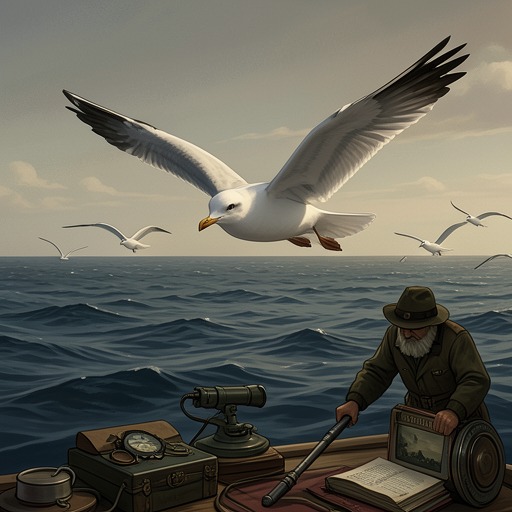
Two silver white gulls take Jonathan to the new world
Jonathan Livingston SeagullThe arrival of two silver-bright gulls marks the transition from Jonathan Livingston Seagull’s solitary mastery of flight to a new world of learning. They do not simply escort him: by matching his most demanding maneuvers, they establish that they can meet him as fliers, while their invitation recasts his exile as the completion of one school and the beginning of another.
The Encounter and the Test
Jonathan is gliding alone through the sky he loves when two gulls appear at his wings. They glow like starlight, their presence gentle and friendly in the high night air. Their flight is so precise that their wingtips remain a constant inch from his own. The closeness is not merely a striking image: it gives Jonathan an immediate way to judge their skill.
Without speaking, Jonathan tests them. He twists his wings and slows to a single mile per hour above a stall, the precarious edge at which flight gives way to falling. Both birds slow smoothly and remain locked beside him. He then folds his wings, rolls, and dives at 190 miles per hour; they follow in flawless formation. Finally, he turns that speed straight upward into a long vertical slow-roll, and they roll with him, smiling. Each maneuver raises the challenge, from control at almost no speed to a steep, fast descent and then a reversal into vertical flight. The visitors pass every test.
Only after recovering to level flight and remaining quiet for a time does Jonathan ask who they are. Their answer is that they are from his Flock, his brothers, and have come to take him higher and take him home. The word home carries a forceful contradiction: Jonathan answers that he has no home and no Flock, because he is an Outcast. He also believes his old body cannot rise more than a few hundred feet above the peak of the Great Mountain Wind. The birds’ welcome therefore meets not just a physical limit as Jonathan understands it, but an identity shaped by expulsion.
From Exile to a New School
The gulls answer Jonathan’s account of himself by saying that he has learned: one school is finished, and another is ready to begin. Their invitation does not deny what exile has cost him or restore his former place in the Flock. Instead, it changes the meaning of the life he has already led. What appeared to be a final separation can now be understood as a completed stage of training.
Jonathan recognizes that they are right. Understanding lights the moment, and he sees that he can fly higher and that it is time to go home. Before leaving, he looks once across the silver land where he learned so much. This last look acknowledges the place of his hard-won knowledge even as he prepares to depart it. He answers that he is ready, then rises with the two star-bright gulls until they disappear into a perfect dark sky.
The passage is marked by action rather than explanation. The newcomers prove their kinship through exact formation and matched skill; Jonathan’s acceptance follows his own test and recognition, not an unexamined surrender to their authority. The sky he has mastered is neither dismissed nor treated as the limit of what can be learned. It becomes the ground from which he can move to a further school.
Perfection, Heaven, and the Meaning of Home
Jonathan’s departure opens into a revised idea of heaven. As he rises, he initially wonders whether this is heaven, then recognizes the irony of analyzing it at the very moment of entering. The Elder later corrects the assumption that heaven is a destination in the ordinary sense: it is not a place or a time, but being perfect. Perfection, in this account, cannot be reduced to a numerical speed, because any number imposes a limit; perfect speed is being there.
That teaching gives the visitors’ promise to take Jonathan higher a meaning beyond altitude. Their flight is a demonstration of extraordinary control, but the journey also advances a learning process in which physical skill and understanding develop together. The two gulls offer a transition, not a final definition: the new school begins after the apparent arrival, and Jonathan continues to learn what heaven and perfection mean.
The word home changes in the same way. Jonathan first rejects it because his exile has left him without a flock to claim. Yet the visitors call themselves his brothers, and he ultimately accepts that it is time to go home. Belonging is thus no longer confined to the flock that cast him out. The encounter establishes kinship through shared ability and opens the possibility of a wider community beyond the old boundary.
Learning Carried Back as Love
The new school’s lessons eventually exceed flight technique. Chiang tells Jonathan that learning to work with time will prepare him to fly into the past and future, and then to begin the harder and more powerful practice of understanding kindness and love. When Chiang vanishes, his last instruction is to keep working on love. The encounter with the two gulls stands at the threshold of this longer education: its exacting flight test demonstrates mastery, while the invitation to a new school points toward what mastery alone cannot provide.
As Jonathan learns, he thinks increasingly of Earth and of gulls still confined by the idea that flight is only a way to get a breadcrumb from a rowboat. He imagines that one there might be struggling to break beyond those limits, perhaps even an Outcast for speaking against the Flock. The more he practices kindness and studies love, the more strongly he wants to return. His way of demonstrating love, he realizes, is to give another gull who asks the chance to see the truth for itself.
That decision extends the encounter’s pattern of recognition and instruction. The two visitors meet Jonathan’s capacity by flying beside him and invite him onward; Jonathan later hopes to meet a learner on Earth with the same openness and offer what he has learned. His departure is consequently not a retreat from the concerns of the world he left. It begins a wider cycle of learning, return, and teaching, in which flight serves both self-realization and the freedom he hopes to make visible to others.